How courier charges are calculated
A courier charge is the billed weight times your rate for that weight slab and zone. Step 1: weigh the packed, taped parcel. Step 2: measure the box in centimetres, length, breadth and height. Step 3: read the billed weight above; under Delhivery One’s rule a parcel under 1 kg is billed on its dead weight, and above 1 kg on the higher of dead and volumetric weight. Step 4: multiply by your rate for that slab and zone from your courier account or aggregator, then add the extras your rate card lists; the Delhivery rate calculator does this for Delhivery. Source: Delhivery help centre, updated 17 Jun 2025, checked 22 Oct 2026.
Volumetric weight: what Delhivery, Blue Dart, DTDC and Speed Post publish
Volumetric weight is the weight a courier assigns to a parcel from its size, and Delhivery is the only one of the five in the table under the calculator that prints its divisor: 5,000 for Delhivery One Surface and Express. Blue Dart bills the higher of gross and dimensional weight, in steps such as 0.25 or 0.5 kg. DTDC lists dimensions among its price inputs, India Post caps a Speed Post Parcel at 35 kg "or volumetric weight as defined", and Shiprocket says the factor varies by courier. Source: each courier’s own page, checked 22 Oct 2026. If your rate card prints another divisor, type it in: that one decides your bill.
Courier charges for a 500 g and a 1.5 kg parcel: worked examples
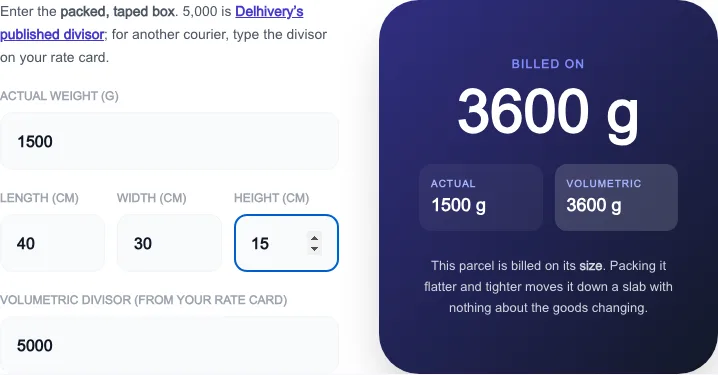
Three parcels at the 5,000 divisor. A 500 g kurta in a 30 x 25 x 8 cm box is 6,000 / 5,000 = 1.2 kg volumetric, so the calculator shows 1,200 g, yet Delhivery One bills 500 g because the dead weight is under 1 kg. The same box with a 1.5 kg two-set order bills at 1.5 kg. Move that order to a 40 x 30 x 15 cm carton and it is 18,000 / 5,000 = 3.6 kg for the same goods. The rupee figure is your slab rate times that weight. Source: calculator output with Delhivery’s rule, worked 23 Oct 2026.
| Parcel | Box (cm) | Volumetric | Calculator shows | Delhivery One bills |
|---|---|---|---|---|
| 500 g kurta | 30 x 25 x 8 | 1.2 kg | 1,200 g | 500 g (dead weight, under 1 kg) |
| 1.5 kg two-set order | 30 x 25 x 8 | 1.2 kg | 1,500 g | 1.5 kg |
| 1.5 kg two-set order | 40 x 30 x 15 | 3.6 kg | 3,600 g | 3.6 kg |
Calculator output for a 1.5 kg parcel
Why is my courier bill higher than the calculator?
Most often the courier measured a bigger box than you entered. On Delhivery One, challenge it under Disputes, then Weight Mismatch, then Raise a Claim, open for delivered shipments only (Delhivery help centre, updated 21 Mar 2024). A parcel that crossed 1 kg in a loose box is billed on size, and your card may use a divisor other than 5,000. The slab rate is also not the whole bill: fuel surcharge, COD charge, out-of-delivery-area charge and return freight sit outside it, so read each from your own rate card.
Speed Post charges and what this calculator does not do
Speed Post is the one courier tariff published for everyone: rates effective from 1 Aug 2026 (S.O. 4241(E)), GST extra, and ₹10 more per article for proof of delivery; read your slab on indiapost.gov.in (checked 22 Oct 2026). This page prints no rupee rate for private couriers, because those are contract data. The calculator is free, needs no sign-up and runs in your browser. Checked by the StitchMagic team, 23 Oct 2026. StitchMagic is a set of free tools and one AI listing agent (ListMagic) for online sellers in India that helps them list faster on Meesho, Flipkart and Amazon.in and sell more.