How to calculate minimum order quantity
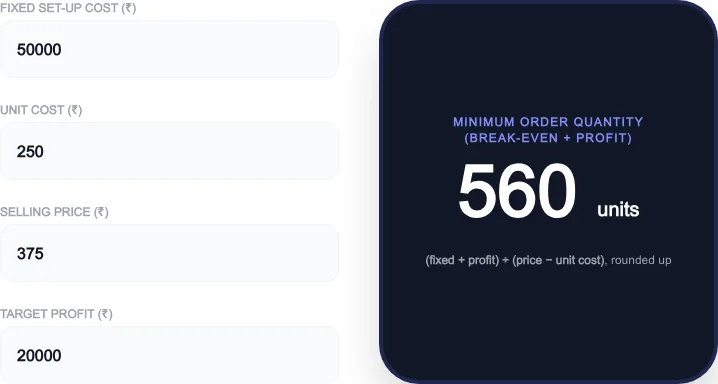
Minimum order quantity is the fixed cost of a run plus the profit you want, divided by what each unit earns you. Step 1: add up the fixed cost of one production run, the money you spend whether you make 10 pieces or 1,000, such as sampling, cutting set-up and printing screens. Step 2: find your margin per unit, the selling price minus the unit cost; if you buy in sets, the price per piece guide gives the cost of one piece, and if you sell on a marketplace, use what one order pays you after fees from the Meesho commission calculator or the Flipkart commission calculator. Step 3: decide the profit you want from the order. Step 4: MOQ = (fixed cost + target profit) / margin per unit, rounded up to a whole unit. With the calculator’s starting values that is (₹50,000 + ₹20,000) / (₹375 − ₹250) = 70,000 / 125 = 560 units. Source: StitchMagic MOQ calculator formula, checked 23 Oct 2026.
MOQ calculator examples in rupees
Example 1, the calculator’s defaults, a Surat kurti maker quoting a reseller after a ₹50,000 sampling and cutting set-up: unit cost ₹250, selling price ₹375, target profit ₹20,000. Margin per unit is ₹125, so the MOQ is 70,000 / 125 = 560 units. Example 2 uses example values for a break-even quote with no profit target: fixed cost ₹30,000, unit cost ₹200, selling price ₹300. Margin per unit is ₹100, so the MOQ is 30,000 / 100 = 300 units, the order size where the set-up is paid back and nothing more. Raise the price in Example 2 to ₹350 and the margin becomes ₹150, so the same set-up needs only 200 units. The tool gives one quantity; it does not build quantity tiers or add shipping. For slab prices to bulk buyers, use the bulk pricing calculator; to set the selling price from your cost first, the wholesale margin calculator. Source: StitchMagic MOQ calculator, checked 23 Oct 2026.
| Example | Fixed cost | Unit cost | Selling price | Target profit | Margin / unit | MOQ |
|---|---|---|---|---|---|---|
| Calculator defaults | ₹50,000 | ₹250 | ₹375 | ₹20,000 | ₹125 | 560 units |
| Break-even only (example values) | ₹30,000 | ₹200 | ₹300 | ₹0 | ₹100 | 300 units |
MOQ meaning in business and supply chain
In business, MOQ is a rule the supplier sets: a factory, wholesaler or printer names the smallest order it will take, because each order carries a fixed cost of setting up, sampling or dispatching that has to be paid back. In a supply chain the MOQ sits at every link: the mill sets one for the fabric, the maker for the garment, the wholesaler for the reseller or marketplace seller. It can be a unit count or a rupee value; a minimum order value (MOV) asks for a minimum amount rather than a minimum number of pieces, and a supplier can use either or both. MOQ is not EOQ: economic order quantity is the buyer’s own order size that keeps ordering and holding costs lowest, and this calculator does not compute it. If the calculator says “No MOQ covers this”, your selling price is at or below your unit cost, so no order size earns back the set-up: raise the price or cut the unit cost first. Checked by the StitchMagic team, 23 Oct 2026. StitchMagic is a set of free tools and one AI listing agent (ListMagic) for online sellers in India that helps them list faster on Meesho, Flipkart and Amazon.in and sell more.
Calculator output with the default inputs