How to create a size chart for your listing
- Type your shop name, if you want it on the chart (optional, up to 30 characters).
- Pick the garment: Kurti, Salwar suit, Blouse or Lehenga.
- Pick Inches or Centimetres; the table converts without retyping.
- Press Copy as text for the description, or Download CSV to edit it in a sheet.
The CSV file is named after the garment and unit, such as kurti-size-chart-in.csv (StitchMagic tool, read 22 Oct 2026).
S, M, L, XL, XXL size in number (inches and cm)
In this generator's kurti chart, XL is 42: a 42-inch garment bust, or 106.7 cm. The label number is the garment's bust in inches, so S is 36, M 38, L 40, XXL 44, and the chart goes up in 2s to 5XL at 50. These are the tool's own presets, not a national standard; a brand sets its own chart, so check the brand's chart before you compare.
| Size | Kurti bust (in) | Kurti bust (cm) |
|---|---|---|
| S | 36 | 91.4 |
| M | 38 | 96.5 |
| L | 40 | 101.6 |
| XL | 42 | 106.7 |
| XXL | 44 | 111.8 |
| 3XL | 46 | 116.8 |
| 4XL | 48 | 121.9 |
| 5XL | 50 | 127 |
Source: StitchMagic size chart generator, kurti preset and its inches × 2.54 conversion, read 22 Oct 2026.
Blouse labels run differently: S is 32 and 3XL is 42 in this tool, 4 inches below the kurti labels. For body sizes, the official Indian data is INDIAsize, a NIFT study under the Ministry of Textiles that scanned 26,324 people; its body size charts have been on the INDIAsize portal since 2 January 2026, and the IN Tag national standards are still under development (nift.ac.in, checked 22 Oct 2026).
What measurements should each garment carry?
A kurti chart carries bust, waist, hip and length; a blouse carries bust, waist, shoulder and sleeve. A salwar suit adds the kurta length to bust, waist and hip, and a lehenga gives waist, hip and length with the blouse bust separately, because the two pieces are sized on their own.
| Garment | What the chart measures | Sizes in the tool |
|---|---|---|
| Kurti | Bust, waist, hip, length | 8: S (36) to 5XL (50) |
| Salwar suit | Bust, waist, hip, kurta length | 7: S (36) to 4XL (48) |
| Blouse | Bust, waist, shoulder, sleeve | 6: S (32) to 3XL (42) |
| Lehenga | Waist, hip, length, blouse bust | 6: S to 3XL |
Source: the generator's four presets, read 22 Oct 2026.
Quote both units where you can. A 38 inch bust is 96.5 cm (38 × 2.54), and giving both removes a conversion the buyer would otherwise get wrong.
Should a size chart be in inches or centimetres?
Either, as long as the chart says the numbers are garment measurements: the label number is the garment's bust, not the buyer's. The tool's own footer says “Allow 1–2 inches of ease”, so a size S garment with a 36-inch bust fits a body bust of about 34 to 35 inches (StitchMagic tool, read 22 Oct 2026).
Centimetres are inches × 2.54, rounded to one decimal, and the generator switches the whole table without retyping. Make the chart in inches for your listing, switch to centimetres for anywhere that asks, and keep the two versions identical.
Add one line under the chart telling the buyer to compare against a garment she already owns, laid flat, rather than her own body.
Where should the chart live on a listing?
Put the chart in a secondary image in an early slot and repeat the numbers as text in the description. We put it second or third, not last, so a buyer checking fit finds it quickly; check the image size your marketplace asks for with the Meesho image resizer.
Search and screen readers do not read text inside an image; the same numbers pasted from Copy as text reach both.
Keep one chart per garment type: a kurti chart and a blouse chart measure different things. If you label stock by size, use the same size codes in your SKU codes.
How do you read your own returns for size problems?
Look at which size comes back, not how many. A style returning across every size usually has a quality or description problem; one returning heavily in a single size has a grading problem in that size, which one row of the chart can fix.
Then read the reason. “Too small” piling up in the larger sizes points to a chart that drifts once the pattern is scaled up, so check the largest sizes first: 3XL to 5XL on a kurti chart, XXL and 3XL on a blouse.
Measure the returned piece against your own chart before you decide the buyer was wrong. If the garment and the chart disagree, the chart or the cutting drifted, and you now know which row to change.
Update the chart when you find a gap, and say on the listing that the measurements were updated. Print the corrected sizes on your labels with the bulk barcode generator, or make a single label in the barcode generator.
What the size chart generator makes, and its limits
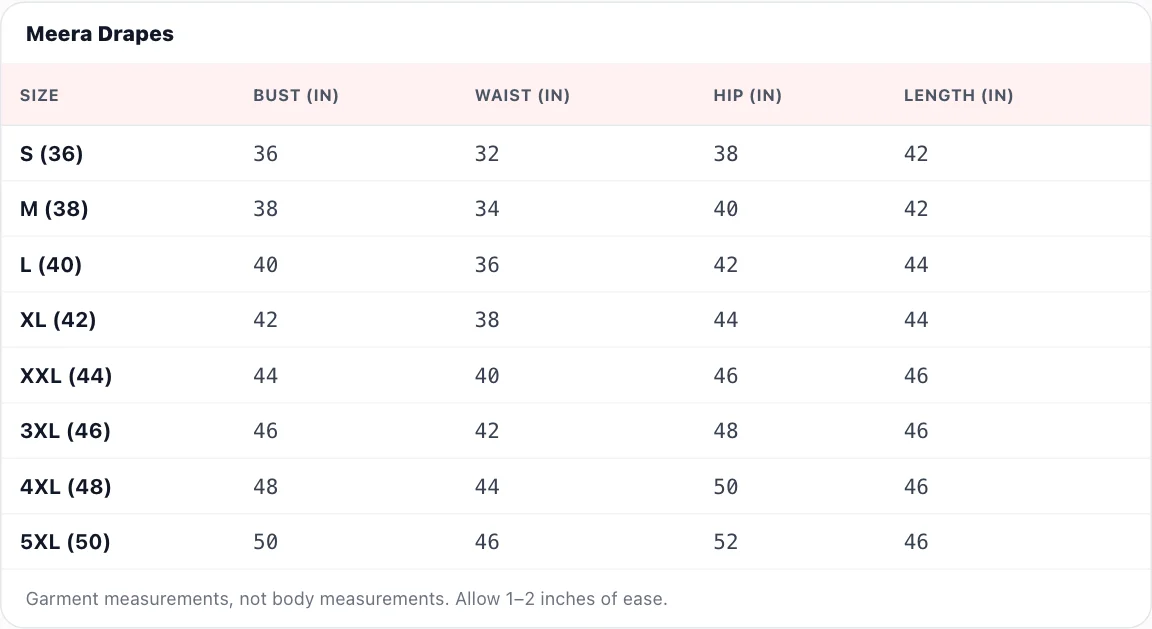
It runs in your browser: nothing is uploaded, and there is no sign-in or phone-number gate. It covers four women's garments only, so there are no men's, kids' or shoe charts, and every value is the tool's preset rather than a national standard. To change a value, download the CSV and edit it; the shop name is not in the CSV, so add it back. For a catalog to send on WhatsApp, use the catalogue maker; more seller tools are on tools for marketplace sellers.