Kutch work dress material wholesale: where each craft is registered
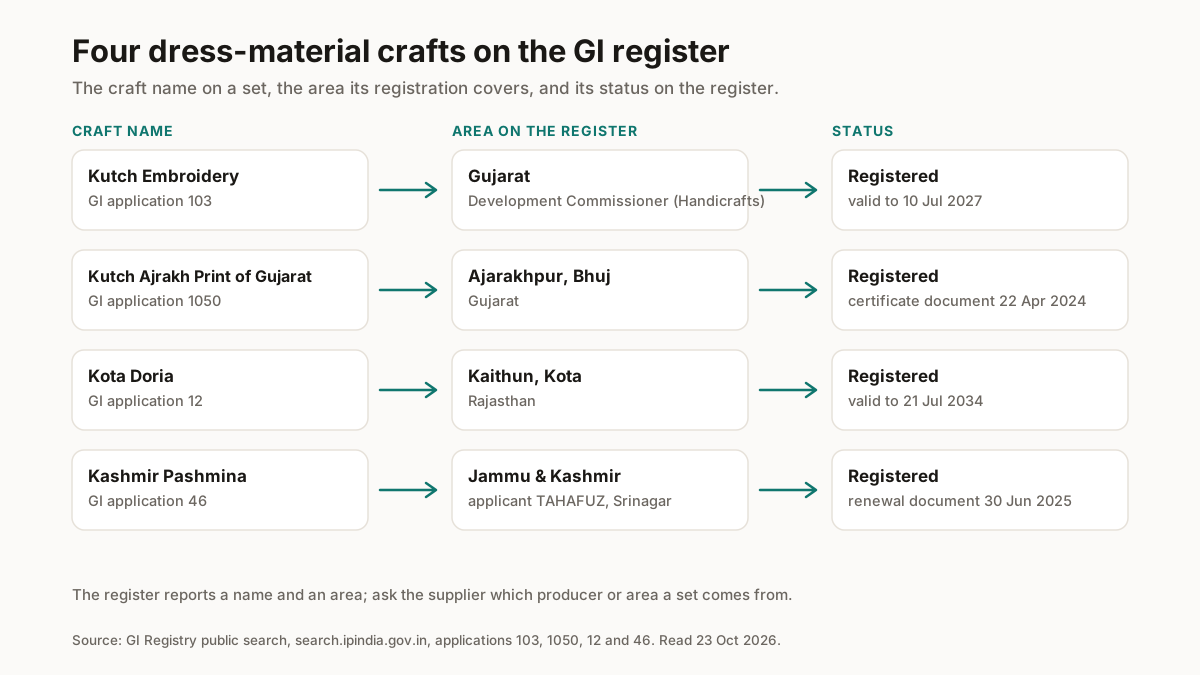
Craft names on dress material sets claim an origin; GI Registry records let you read that claim. Kutch Embroidery (application 103) is registered for Gujarat to Development Commissioner (Handicrafts), Ministry of Textiles. Kutch Ajrakh Print of Gujarat (1050) belongs to Ajarakhpur Hastkala Vikas Sangathan, Ajarakhpur, Bhuj, certificate document dated 22 Apr 2024; filed as textile print (classes 24, 25), Ajrakh speaks to printing, not base fibre. Kota Doria (12) belongs to a foundation in Kaithun, District Kota, Rajasthan. Kashmir Pashmina (46) covers Jammu & Kashmir, renewal document 30 Jun 2025. All four GI records read 23 Oct 2026.
Kashmiri dress material is not Kashmir Pashmina. On wholesale quotes, “Kashmiri” names an embroidery look, saying nothing about cloth underneath. Kashmir Pashmina is GI application 46, registered for Jammu & Kashmir with TAHAFUZ, Srinagar, as applicant; it covers Pashmina itself. Get fibre named in writing before paying Pashmina prices.
Kutch work dress material wholesale mein lene se pehle GI register par craft ka naam dekhiye: Kutch Embroidery application 103, Gujarat. Supplier se cotton ka percentage aur har piece ki length likhit mein lijiye; “pure cotton” ka matlab 85% ya usse zyada cotton hai.
For printed sets see our Surat cloth market page; for block prints, our Jaipur market page. Each covers what to inspect while there. Stitched suits have their own page: wholesale ladies suits.
Pure cotton dress materials wholesale: what to check
“Pure cotton” has a measurable meaning: 85% or more cotton by weight. GST portal headings split woven cotton fabrics (5208, 5209) from cotton mixed mainly with man-made fibre (5211), checked 23 Oct 2026. Blends get classified by whichever fibre predominates by weight (Section XI Note 2(A)). In search results on 23 Oct 2026, one dress material set titled pure cotton described its own fabric as viscose further down, so take cotton percentage in writing.
Length of each piece
Ask for top, bottom, dupatta lengths in metres; note them on each order. If the tailor runs short of cloth, the complaint reaches you as a bad review.
Width of the fabric
Width decides whether a length is enough, and two sets quoted at one length on different widths are not equivalent.
Colourfastness
Ask before buying depth in strong colours. Bleeding sets ruin finished suits after your customer has also paid her tailor.
Whether the dupatta matches the top
Hold dupatta and top together in daylight. Shade gaps hidden while a set lies folded show once it is stitched.
Dress materials for resellers: where they sell
On any channel, listing text does a shop assistant’s job: it says a dress material set is unstitched and gives each piece length. Meesho, Flipkart or Amazon buyers decide from titles and photos, so put “unstitched” in your title itself. WhatsApp or Instagram chats let you answer questions, which helps with Kutch work or Ajrakh sets where buyers want embroidery close-ups first.
| Meesho | |||
|---|---|---|---|
| Buyer arrives | Searching and comparing on price | Discovering while scrolling | Already knows and trusts you |
| Marketplace commission | 0% on all categories (Meesho pricing page, 4 Oct 2026) | None — you sell direct | None — you sell direct |
| Return rate | Check yours in the Meesho Supplier Panel | Your own order records | Your own order records |
| Listing rules | QC checks every catalog; image guidelines are in the Supplier Panel | The platform’s own content rules | The platform’s own content rules |
| What sells | Everyday basics at sharp prices | Distinctive, photogenic, occasion wear | Mid to premium, and repeat orders |
| What it needs from you | Volume and price discipline | A look and consistent posting | An audience you already built |
Meesho commission source: “0% Commission rate across all categories”, Meesho pricing page (supplier.meesho.com/pricing), retrieved 4 Oct 2026. You still pay shipping, and the return shipping fee for your product is shown in the Meesho Supplier Panel — enter yours in the break-even calculator.
Embroidered dress material wholesale: single piece or full catalog
Ask suppliers of embroidered dress material two things before talking quantity. First, whether a single piece sells at catalog rate or only as a full design set: that decides how much stock a test order ties up, and answers “single piece dress material at wholesale price” honestly.
Second, whether embroidery is hand or machine work. Turn a panel over, inspect its reverse with your supplier, then write that answer on your order. Buy across prints and designs rather than deep in one; a print that does not move is hard to sell on.
Wholesale dress material suppliers: what to ask
Get these four written on each quote or invoice:
- Fibre percentage; “pure cotton” means 85% or more by weight.
- Top, bottom and dupatta lengths, plus fabric width.
- HSN line, such as 6307 90 11 for a hand-printed cotton set.
- For GI craft names, which registered producer or area each set comes from.
Dress materials supplier list
We are building a list of dress material suppliers by fabric and craft, and by whether each sells single pieces. Every number on it comes from a supplier who asked to be listed.
Your number is used to send the list and nothing else.
Dress material wholesale rate: what changes your margin
Dress material sets in chapter 63 are taxed at 5% when invoice value is ₹2,500 or less per piece, 18% beyond that, since 22 Sept 2025 (PIB, GST Council’s 56th meeting). CBIC’s rates FAQ reads that value as transaction value, not retail price. A set invoiced at ₹2,400 pays 5% (₹120); one at ₹2,600 pays 18% (₹468). Figures already in our calculator are marked examples; swap in yours. No rates appear here: a dress material rate means little without fibre, lengths and type of work beside it.
Same garment, three channels
The numbers below are example inputs. Replace each one with your own: your cost and price, your shipping and return fees from the Meesho Supplier Panel, and the return rates and ad spend from your own orders.
Return rate on each channel (example inputs)
Ad spend per order (example inputs)
Meesho
₹196
per order after returns · 28% margin
₹301 on a delivered order
returns + ads + any per-order fee
₹256
per order after returns · 37% margin
₹306 on a delivered order
no commission, ads to be found
WhatsAppMOST LEFT
₹300
per order after returns · 43% margin
₹321 on a delivered order
no commission, no ads
On these example numbers the same piece leaves ₹104 more per order on WhatsApp than on Meesho — which is the argument for choosing the channel before choosing the stock. For the full picture including GST and a target margin, use the break-even calculator.
Unstitched dress material: HSN code and what the listing states
Hand-printed unstitched dress material has its own HSN lines under 6307 90, which DGCIS tariff text describes as “Dress materials hand printed” (GST portal master, checked 23 Oct 2026):
| HSN line | Fibre |
|---|---|
| 6307 90 11 | Cotton |
| 6307 90 12 | Silk |
| 6307 90 13 | Man-made fibres |
Sets that are not hand printed fall outside those lines; check each one’s fabric line on our fabric HSN codes page. Stitched dresses: our dress HSN code page.
Make each dress material listing state every piece length, the fabric and that the set is unstitched. A buyer who expected a ready-made suit returns it, and that return comes from your listing, not the goods.